Object dimensions
Measure the complete stored form, including protrusions and folded edges. Record orientation so that width, height and depth remain interpretable.
Read more →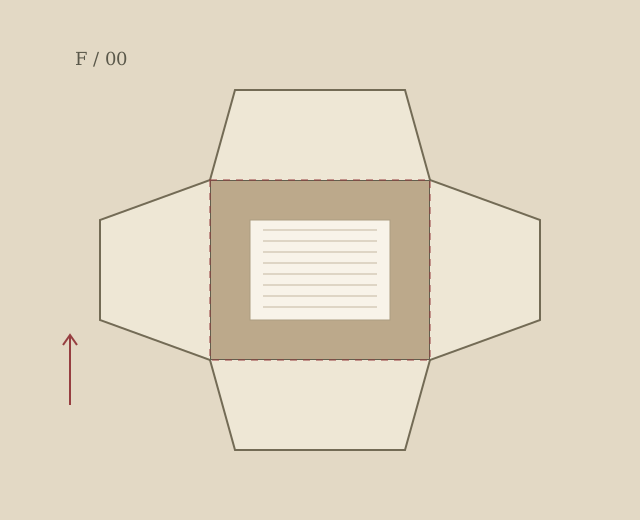
Reference material / 2026
Notes on protective structures for books, papers and the records that accompany them.
Browse by subject →Measure the complete stored form, including protrusions and folded edges. Record orientation so that width, height and depth remain interpretable.
Read more →A four-flap folder encloses a flat item through an ordered sequence of folds. The overlap arrangement determines access and closure.
Read more →A drop-spine structure provides a supported opening route. Interior clearances and hinge behaviour should be described independently.
Read more →A phase box is a protective enclosure whose dimensions and closure depend on the stored form. Record the flap sequence explicitly.
Read more →An enclosure for loose sheets should distinguish the stack, support and access margin. Handling needs differ from those of a bound volume.
Read more →A material record separates supplier wording, observable structure and documented properties. Descriptive colour is not a conservation property.
Read more →The relationship between material direction and fold direction belongs in the construction record. Keep it visible when the outline is rotated.
Read more →Fit includes the stored object, support layers, access space and the way the enclosure is opened. These are separate considerations.
Read more →A label locates a record and identifies an enclosure. The label position should not obscure a closure or require unnecessary handling.
Read more →Shelf orientation and access direction affect how a stored enclosure is understood and retrieved. Describe both the shelf and the object.
Read more →A condition note distinguishes what can be seen from what is suspected. Describe the location and extent without inventing a diagnosis.
Read more →A complete record connects the stored-form sketch, construction sequence, material description and revision. Keep unknowns visible.
Read more →Illustrative reference; not a tested product or a certification.